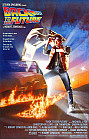
Back to the Future
"Back to the Future" (1985) follows teenager Marty McFly as he’s accidentally sent back to 1955 in a time-traveling DeLorean built by his eccentric friend Doc Brown, where he must ensure his teenage parents fall in love or risk never being born. This sci‑fi comedy is an excellent choice for English learners because it contrasts casual 1980s teen slang with rapid, excited 1950s speech, offering a natural bridge between two American eras at a moderate‑to‑fast pace. The title contains 546 vocabulary entries, with a dominant CEFR level of B2 (337 words, 62%); the full distribution includes A2 (17 words, 3%), B1 (124 words, 23%), C1 (62 words, 11%), and C2 (6 words, 1%), giving an overall difficulty of B2. On SaveWordly, learners can save these 546 words to their personal library, review them with spaced‑repetition flashcards, and practice speaking with an AI tutor that recreates Marty’s laid‑back tone and Doc Brown’s rapid, enthusiastic delivery. This turns key scenes—like the “Great Scott!” moment or the “1.21 gigawatts” line—into interactive speaking drills where you rephrase dialogue, answer character questions, and build fluency. The title is best suited for intermediate (B1–B2) learners who want to bridge everyday conversation with the excitement of time‑travel vocabulary and 80s pop culture references.
How SaveWordly Works
Browse the vocabulary list and save words you don't know to your personal list.
Learn the words before watching — so nothing interrupts you while enjoying the show.
After watching, practice speaking about what you saw with our AI conversation tutor.
Why "Back to the Future" for English learning — in English
"Back to the Future" is a masterpiece of Sci-Fi, Adventure, and Comedy from 1985 that offers English learners a uniquely rich listening and vocabulary experience. The film is built around fast-paced, natural dialogue between characters from different backgrounds—teenager Marty McFly, eccentric scientist Doc Brown, and a 1950s family. This variety exposes learners to conversational English in multiple registers: casual banter among friends, excited exclamations, formal explanations, and even heated arguments. The cultural context—1980s America and 1950s nostalgia—gives learners authentic references to music, fashion, and social norms, making the language more memorable. Because the plot relies on witty wordplay, misunderstandings (like "Calvin Klein" as a name), and idiomatic expressions, learners absorb English in context rather than through isolated textbook sentences. The film's humor and adventure keep motivation high; you want to understand every joke and plot twist, which drives comprehension naturally.
"Back to the Future" Vocabulary Level — in English
An analysis of the movie’s script reveals a total of 546 vocabulary entries that are essential for understanding the story. The dominant CEFR level is B2 (upper-intermediate), with a detailed breakdown as follows:
A2 — 17 words (3%)
B1 — 124 words (23%)
B2 — 337 words (62%)
C1 — 62 words (11%)
C2 — 6 words (1%)
What does this mean for learners? If you are at a B1 level, you will encounter 337 B2 words that push you to expand your active vocabulary. The 62 C1 and 6 C2 words add a layer of nuance—words like "flux capacitor" (technical) and "paradox" (abstract). For an A2 learner, the movie will be challenging but achievable with support: 3% of words are at their level, and 23% are at B1, which is often the next step. The high B2 concentration makes "Back to the Future" ideal for intermediate learners who want to solidify their ability to understand natural speech, handle idioms, and follow complex narratives without relying on subtitles in their native language.
English Style in "Back to the Future" — in English
The English learners absorb from this film is primarily American English with a neutral to slightly Californian accent (Michael J. Fox’s Marty) and a more theatrical, fast-talking style from Christopher Lloyd’s Doc. The register shifts constantly: Marty uses informal slang ("heavy," "dude," "nobody calls me chicken"), Doc employs enthusiastic, semi-technical speech ("1.21 gigawatts!"), and the 1950s characters speak with a different generational tone (polite, slightly formal). This mix teaches learners to recognize informal phrasal verbs ("get out of here," "go ahead," "look out"), idioms ("make like a tree and leave," "you’re my density" – a playful mispronunciation), and cultural references ("Johnny B. Goode"). The pace is generally fast, especially in high-action scenes, which trains learners to process English quickly. There is also deliberate repetition of key phrases (e.g., "Roads? Where we're going, we don't need roads."), which reinforces retention. Overall, viewers absorb a lively, authentic slice of American English from the 1980s that remains highly understandable today.
SaveWordly + "Back to the Future" — in English
To make the most of "Back to the Future" for your English learning, use SaveWordly as your companion tool. Before watching, open the movie script or subtitles in SaveWordly and save the 546 vocabulary entries you want to master. The app organizes them by CEFR level, so you can focus on the B2 words first. Then study the words using SaveWordly’s flashcard system: each card shows the word, its meaning in English, example sentences from the movie, and audio pronunciation. After watching each scene or episode (if you break the film into parts), use the AI speaking practice feature. You can respond to prompts like "Explain what Doc Brown says about time travel" or "Describe Marty’s plan to fix the timeline." The AI corrects your grammar, suggests better vocabulary, and even imitates the movie’s tone. This three-step method—save, study, speak—ensures you don’t just watch passively but actively build language skills. SaveWordly works with any streaming platform; just paste the text or import the script. It's a natural way to turn a great movie into a personalized English course.
What Level After Finishing "Back to the Future"? — in English
If you thoroughly study the 546 vocabulary entries from "Back to the Future" using SaveWordly, your English proficiency will see a measurable jump. Based on the CEFR data, you will have mastered 337 B2 words and become familiar with 62 C1 words and 6 C2 words. For a learner starting at a solid B1 level, finishing this film and its vocabulary will bring you confidently into B2+ territory—you’ll understand more complex movie dialogues, news reports, and everyday conversations with ease. If you were already B2, you will strengthen your grasp of idiomatic and technical language, pushing you toward C1 readiness. The 17 A2 and 124 B1 words serve as a useful review, filling any gaps. And because you learned through context and repetition, your listening speed and comprehension will improve dramatically. In short: after "Back to the Future," you will have increased your active vocabulary by roughly 400 useful words, gained confidence with fast American English, and be ready to tackle more advanced content—all while enjoying one of the most entertaining films ever made.
Top Words